
ACL Tear FAQ: Clear answers to your common doubts regarding ACL tear and its management
Dr Firoz Ahmed MS (Ortho) Jan 26
ACL tear is a common injury, specially in the North East. There are still many doubts and confusions around this topic.
Dr Firoz Ahmed, leading Sports Injury specialist in Guwahati tries to answer some basic questions and clear a few doubts.
1. What is an ACL and how did I tear it?
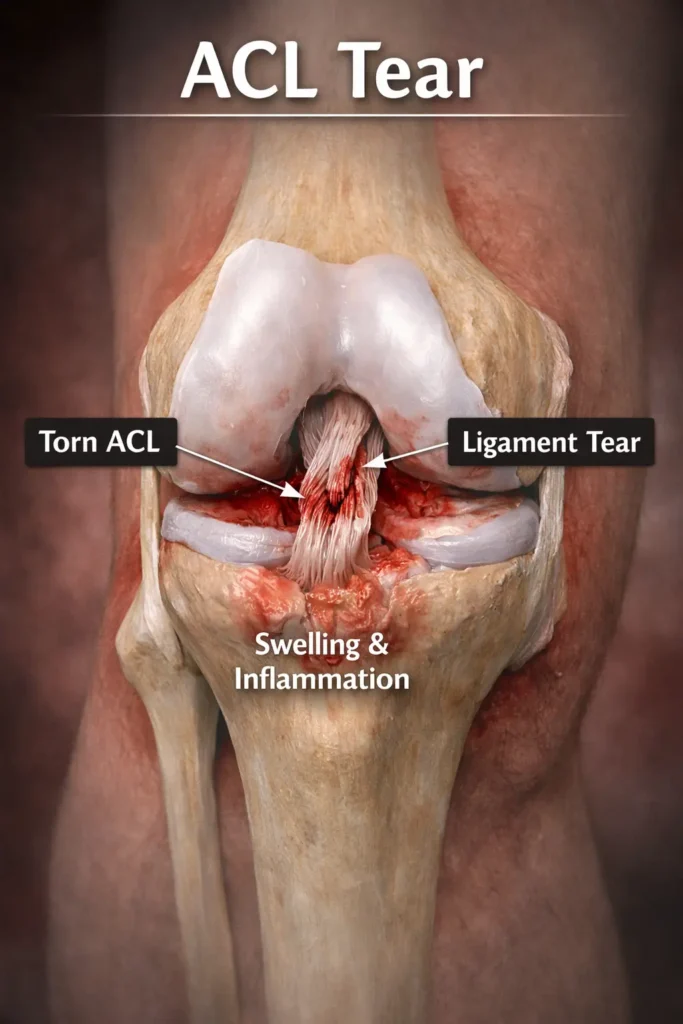
Ans: ACL means Anterior Cruciate Ligament. It is a rope like tissue found in the knee joint which binds the thigh and leg bones together. The most common way it is torn is while sustaining a twisting injury to the knee, usually during sports or fall.
2. What are the common symptoms of an ACL tear?
Ans: After an ACL tear, the patient experiences pain, swelling and absence of giving way (instability) of the knee. Pain and swelling usually subsides after a period of time, but instability usually persists.
3. I heard a “pop” while playing football—does that always mean my ACL is torn?
And: Hearing the “pop” may not necessarily mean a torn ACL. It can be diagnosed only after a careful and thorough examination.
4. How will my doctor confirm an ACL tear — do I need an X-ray or MRI?
Ans: The most important factor in diagnosing an ACL tear is taking a proper history of the patient and then a thorough clinical examination by your doctor. X-ray may be done but usually doesn’t show any change. While MRI is generally advised to confirm the diagnosis and find out other associated injuries.
5. What should I do immediately after the injury (first-aid, icing, immobilisation, when to see a specialist)?
Ans: Rest, Ice, Elevation, light compress
6.Can a torn ACL heal by itself or without surgery?
Ans: A fully torn ACL does not heal on its own. A partial tear may heal sufficiently to allow for good function.
7. Do I need ACL reconstruction surgery — how do we decide?
Ans: The decision about surgery depends on a few factors such as
- Type of tear
- Age of patient
- Functional demand of the patient etc
- Other associated injuries
8. What are the different surgical graft options?
Ans: ACL repair is usually not successful. That is why most surgeons attempt to do ACL reconstruction, where a tendon is fixed in place of the torn ligament.
When that tendon is taken from the patient’s own body it is called an autograft. It doesn’t cause any problem as its function is taken over by other tendons near it.
An allograft is a tendon which is taken from a dead body (cadaver) who had consented for organ donation. (Not commonly availablein India)
9. Where does the autograft come from?
And: The autograft source can be
- Hamstring (near the knee)
- Peroneus longus tendon (near the ankle)
- Patellar tendon (BTB)
10. What is the difference between “Open” surgery and “Arthroscopic” (Keyhole) ACL surgery?
Ans: Open surgery means cutting open the knee joint and exposing everything inside. It leads to too much tissue damage and the results are bad. Therefore open surgery is never advised. Arthroscopic or Keyhole surgery means making 2-3 small holes in the knee and using advanced equipment, the whole surgery is performed. This causes minimal tissue damage and excellent outcome.
11. How long will I be in hospital and what does immediate post-op care involve?
Ans: Patients are generally discharged on the next day following surgery. For post op care, refer here.
12. How long is the total recovery and when can I return to work, walking, and sports?
Ans: Patients are able to walk from the next day itself. Return to office work can be as early as 1-2 weeks. Driving a car takes around 6 weeks while riding a bike takes 4-6 months. Return to professional sports takes at least 6 months.
13. What are the possible risks and complications of ACL surgery?
Ans: ACL reconstruction surgery is a generally safe procedure. Uncommon complications include infection, graft tear etc.
14. What is the likelihood of re-tearing ACL?
Ans: Once the reconstructed ligament heals, it behaves exactly like the original one. Suffering a similar injury can result in tearing of this ligament too.
15. How much will ACL surgery and rehabilitation cost in Guwahati — are there government schemes or insurance (MHIS/TPA) that cover it?
Ans: The cost of the surgery depends on many factors including type of implants used, bed options etc. It can vary from 80k-1.4 L. TPA and MHIS cover this procedure.
16. If I delay surgery or choose not to have surgery, what problems can happen and when should I definitely have the operation?
Ans: Delaying the surgery results in damage to cartilage, meniscus and other structures as well as wasting of the muscles. Too much delay can result in less than expected outcome after surgery and development of early arthritis.
17. Will I be able to walk immediately after the surgery, or will I be bedridden?
And: You will be able to walk the next day following surgery.
18. As an athlete in the North East, when can I realistically go back to playing competitive football or sports?
Ans: Yes, definitely.
19. Is physiotherapy mandatory, and can I do it in my hometown outside of Guwahati?
Ans: Initial exercises regimen can be followed by the patient himself. The physiotherapy can be done in almost all places in North East today as there are a lot of qualified physiotherapists practicing.
20. Will I have permanent scars on my knee after the procedure?
Ans: Since it is a keyhole surgery, it will not have a big permanent scar.
Click here for detailed FAQs on other topics
Medical review by Dr Firoz Ahmed, MBBS, MS (Orthopaedics) – Consultant Orthopaedic Surgeon, Guwahati.
Last Updated: Jan 2026
Disclaimer: This post is for general awareness only and cannot substitute for medical knowledge. Any treatment decision has be based on actual patient examination and consultation by an experienced medical professional.
References:
- American Academy of Orthopaedic Surgeons (AAOS)
- Mayo Clinic
- Cleveland Clinic
Dr Firoz Ahmed for expert ACL Tear Treatment in Guwahati.
OPD Schedule: Mon – Sat (9AM to 4 PM)
Address: ARHI Hospital,11th Mile, Jorabat,Khanapara