
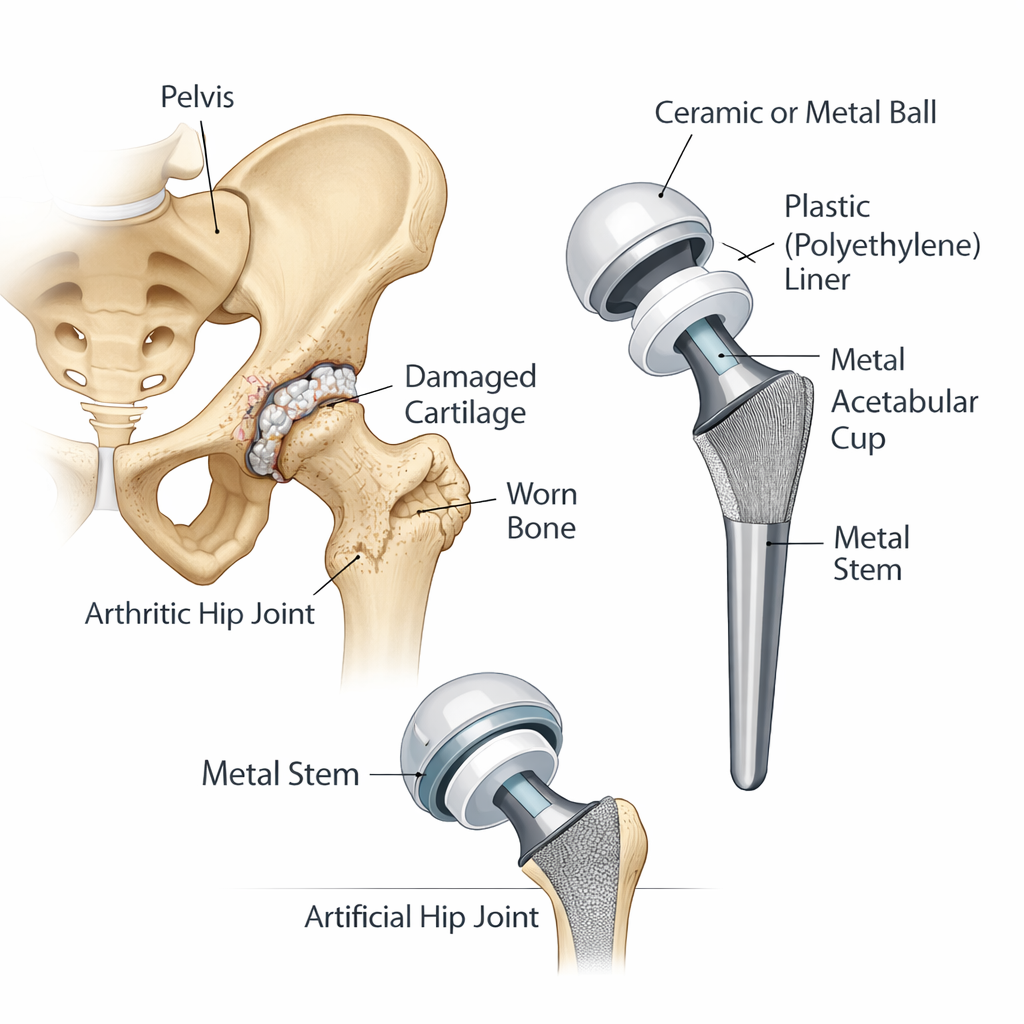
Hip Replacement in Guwahati – A complete guide by Dr Firoz Ahmed
What are the indications of Hip Replacement?
It is indicated in a variety of diseases, such as
- Severe arthritis of the Hip
The hip bone and cartilage can be severely damaged due to Rheumatoid Arthritis, Osteoarthritis, secondary arthritis etc
- AVN of the Hip
The head of the Femur (ball of the hip joint) may become dead due to a number of reasons like injury, infection etc.
- Fracture
In some cases where the hip joint is severely fractured or when the patient is an elderly person, it may be better to do Hip Replacement as the primary surgery.
- Failed surgery
In those cases, where previous surgery on the hip has failed.
How to know if you may need Hip Replacement?
You may need Hip Replacement if you are suffering from the following:
- Severe persistent Hip pain
- Severe stiffness of the Hip
- Pain persists at rest
- Daily activities like walking, stairs etc are limited
- You have to take painkiller daily/ frequently
What are the alternatives of Hip Replacement surgery
Non-surgical methods are always the first line of treatment. They include
- Medications
- Physiotherapy
- Exercises
- Lifestyle modifications
- Orthobiologics
Most patients will get better without surgery. Those who don’t recover will have to proceed for Hip Replacement.
Benefits of Hip Replacement surgery
Hip Replacement is a highly successful procedure. The patients experiences a sea change in his or her lifestyle after the procedure
- Pain goes away
- Hip movement improves a lot
- Daily activities become much easier and comfortable
- Sleep improves
Type of Hip Replacement
Total Hip Replacement
In this procedure, the whole hip joint including the ball and socket is replaced
Hemi Hip Replacement
Here, only the ball part is removed and the socket is undisturbed
Revision Hip Replacement
When a previous Hip Replacement surgery fails for any reason, then this type of advanced surgery is performed.
Preparations before Hip Replacement surgery
Medical and Pre Anaesthetic Evaluation
Blood tests, ECG, Echo, X‑ray, and general health assessment.
Medication Review
The current medications, if any will be evaluated and some may be paused or added.
Exercises
The current medications, if any will be evaluated and some may be paused or added.
Family support
Arrange walking aids, family support and caregiver, if needed.
Insurance and TPA documentation
Steps of Hip Replacement surgery
The major steps in the surgery are:
- Incision and exposure of the damaged joint
- Removal of the damaged bone and cartilage
- Preparation of the socket and Ball
- Measurement of the probable implant accurately
- Fixation of the finalimplant
- Closure
How is the recovery after Replacement surgery
Hospital Stay
Usually 1-2 days depending on recovery.
Exercises
Starts within 12-24 hours after surgery. Easy set of exercises that the patient can do on their own.
Walking Support
Starts with Walker or crutches the next day itself, progressing to independent walking.
Pain Management
Pain block and special medications relieve pain without causing side effects. It leads to comfortable stay for the patients and also helps them in doing exercises confidently.
Return to Normal Activities
Walking independently: 1-2 weeks
Driving: 4–6 weeks
Office work: 2-3 weeks
Full recovery: 6-12 week
Life after a Hip Replacement surgery
The patient generally enjoys an active and improved life after Hip Replacement.
Daily activities like walking, climbing stairs etc no longer cause pain and restriction. Infact, most patients regain their love of walking and travelling after Hip Replacement.
The constant pain that they had to bear earlier and the medicines that they had to take become a thing of the past.
Risks and Complications of Hip Replacement
With modern medical methods and techniques, risks and complications have been mostly brought under control. Still few of them are:
- Infection
- Wound disturbances
- Deep Vein Thrombosis etc
- Implant loosening
- Pain
The complication rates can be further managed by choosing an experienced surgeon and a hospital with good facilities. Further, complying with the rehab program as suggested by your doctor can help reduce the complications and ensure an excellent outcome.
Cost of Hip Replacement in Guwahati
The cost varies depending on:
- Type of implant used
- Hospital facilitiesSurgeon’s experience
- Type of surgery
- Length of hospital stay
- Health status of the patient
Compared to metro cities, knee replacement surgery in Guwahati is much more affordable while maintaining excellent quality standards.
We, at ARHI Hospital, do not compromise on implant quality and prefer to use only MNC quality implants. Please contact us to know the individual package as per your patient condition.
How to choose a Hip Replacement Surgeon in Guwahati
You should look for:
- Specialized Training in Joint Replacement
- High Surgical Volume and Experience
- Good Patient Reviews and Outcomes
- Modern Hospital Infrastructure
- Strong Rehabilitation Support Team
Guwahati has emerged as a major healthcare hub in Northeast India for orthopaedic care. Patients from Assam, Meghalaya, Arunachal Pradesh, and neighboring states regularly travel here for advanced joint replacement treatment. ARHI hospital is located at a central place with easy accessibility from all corners of the North East.
At ARHI Hospital, patients receive comprehensive knee replacement care including:
- Detailed pre‑surgery evaluation
- Advanced surgical techniques
- MNC quality implants
- Personalized rehabilitation program
- Simple to follow rehab programs
- Affordable treatment plans
- Ethical and transparent medical advice
Our mission is to help patients walk pain‑free and return to an active, independent life.
1. How long does a hip replacement last?
Modern hip implants usually last 15–25 years or more, depending on age, activity level, and body weight.
2. How painful is hip replacement surgery?
Pain is managed very well due to modern methods.
3. How many days do I need to stay in the hospital?
Usually patients need to stay only 1-2 days.
4. When can I walk after hip replacement?
Majority of the patients walk the next day after surgery.
5. Will I be able to sit cross-legged or squat after surgery?
It is possible but usually not recommended as a routine.
Medical review by Dr Firoz Ahmed, MBBS, MS (Orthopaedics) – Consultant Orthopaedic Surgeon, Guwahati.
Last Updated: Jan 2026
Disclaimer: This post is for general awareness only and cannot substitute for medical knowledge. Any treatment decision has be based on actual patient examination and consultation by an experienced medical professional.
References:
- American Academy of Orthopaedic Surgeons (AAOS)
- Mayo Clinic
- Cleveland Clinic
Dr Firoz Ahmed leading Orthopaedic Surgeon for Hip Replacement in Guwahati.
OPD Schedule: Mon – Sat (9AM to 4 PM)
Address: ARHI Hospital,11th Mile, Jorabat, Khanapara