
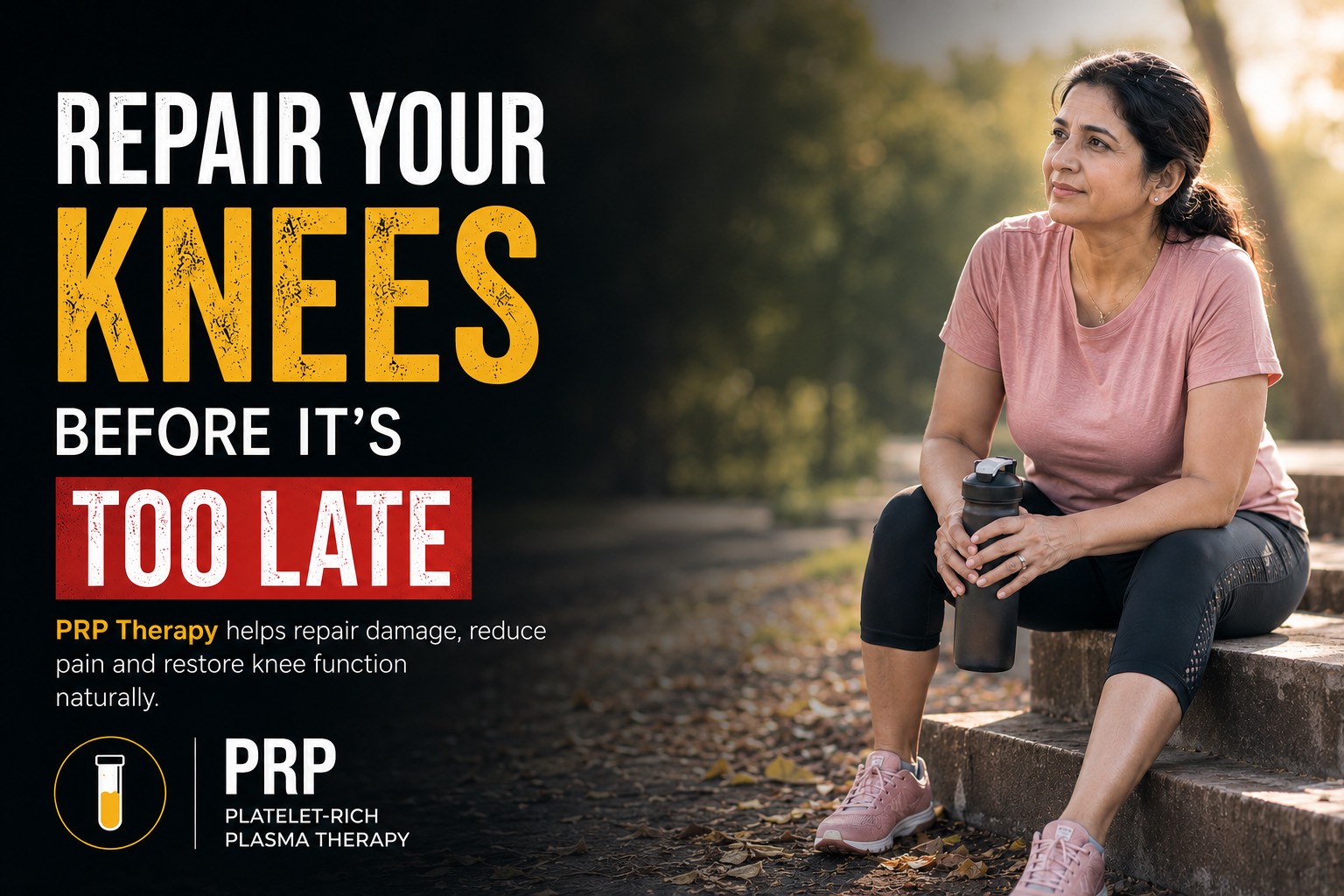
Celebrities. Pain Clinics. Viral Videos.
Anyone browsing through social media must have come across the term “PRP‘.
There would likely be many tall claims of “Magic drug” or “Wonder Drug“
Patients from Guwahati and across North East commonly suffer from knee pain and are increasingly becoming aware about newer techniques such as these.
How much of it is true? Lets cut the hype and go deeper into it.
What Exactly Is PRP?
PRP is a type of Orthobiologic.
It is harvested from the patient’s own blood (usually 10-50 ml) and centriguge it in a lab machine to get the platelets (small blood cells) in higher concentration.
When the final concentrated preparation is injected into the patient’s affected area, it releases growth factors which promote natural healing of the area.
Thats it.
No Artificial Medicine. No Foreign Substance.
So, Why Is Everyone Talking About PRP?
PRP offecr some real benefits which attract everyone easily.
- Minimally Invasive
- No Surgery
- Faster recovery
- Natural healing
However, what actually matters is proper patient selection to get optimum results.
Walk Pain -Free Again
Consult with Dr Firoz Ahmed, a leading Knee specialist in Guwahati
How Can PRP Help in Knee Pain?
PRP can help patients with knee pain when conservative therapy with medications and exercises fail.
It works best when:
- Pain has started but knee is only moderatly damaged
- There is swelling after walking or activity
- Knee is mildly stiff but movement is still good
- Patient is still active
In such cases, PRP can:
- Reduce pain
- Make walking easier
- Reduce swelling
- Improve day-to-day activities
The biology of PRP is elegant. The problem isn’t the science behind it – rather how it is offered to the patient as a magical cure.
But! Be Aware Of The Hype
PRP is not a magic bullet.
When proper indications and patient selection is not followed, PRP will also tend to fail.
Being a biological agent, PRP needs living, repairable tissue to work its effect. It also depends on the repair capacity of the patient’s body.
If the knee is severely damaged, meaning there is hardly any cartilage left in the knee, then PRP injections will not help.
Where To Avoid PRP
- Advanced bone-on-bone arthritis
- Deformity
- Complete Tendon or Ligament tears
- Active infection
- Patients with poor immunity or very advanced age
- Certain Blood clotting disorders
What Does The Evidence Say?
STRONG
Knee Arthritis (Early to moderate changes)
STRONG
Tennis Elbow
STRONG
Plantar Fasciitis (Heel Pain)
MODERATE
Rotator Cuff Tear
MODERATE
Achilles tendinopathy
EVOLVING
Acute Sports Injuries
How Soon Can You Expect Results
This is another area of misconception.
Many patients expect immediate relief after PRP injection.
PRP is not a painkiller.
It doesn’t give instant relief.
Typical timeline:
- 1-2 days: Mild discomfort after injection in some patients
- A few weeks: Early improvement
- 8-12 weeks: Gradual relief
Regular exercise and medications have to be continued after the injection for optimum results.
Can PRP cure Arthritis?
PRP helps in natural repair of the knee damage and controls inflammation, thereby relieving symptoms and improving daily comfort.
In early cases with mild arthritis, PRP may control the disease to a large extent.
However, in late cases, the effect of PRP is limited.
Knee arthritis is multifactorial and relentless. A multimodal approach is therefore required.
Can PRP help in Meniscus and Ligament Tears?
In mild or partial tears of Meniscus and Ligaments, PRP injection can help in non-surgical repair and healing.
In indicated cases, usually medications and rehab exercises are tried first and in many cases that is enough.
Where such conservative measures fail, PRP injection can be tried rather than going directly for surgery.
However, in case of full and extensive tears, PRP should not be tried.
Can PRP help in Avoiding Knee Surgery?
Early to moderated cases respond well to PRP injection. In such cases, the healing can be sufficient enough for the patient to avoid going for surgery.
In patients who have already reached the end-stage, where surgery is the only viable solution, PRP injection will not help.
Cost Of PRP Treatment in Guwahati
The cost of a single PRP injection can very from 15k – 25k.
The cost depends on multiple factors like PRP kit, other orthobiologic used, clinic setup etc.
All PRP Is Not Same
The effect of PRP depends on many technical factors, most important being the number and quality of platelets.
There are many different ways to prepare PRP and various commercial kits available.
Many patients don’t get desired results because of lack of proper technique by a untrained persons and use of low-quality commercial kits.
Dr Firoz Ahmed conducts and oversees the whole process in a controlled, standard and sterile manner and uses high-quality kits and lab equipment to give patients the maximum chance of success.
Walk Pain -Free Again
Consult with Dr Firoz Ahmed, a leading Knee specialist in Guwahati
Dr Firoz Ahmed
Joint Replacement, Sports Injury Specialist and Joint Preservation Surgeon
OPD: Mon–Sat | 9 AM – 4 PM
Location: ARHI Hospital, Jorabat (near Guwahati, Khanapara)
Learn More About PRP
Contact us now!